In Stanford GSB’s early days, the top industry for alums centered around the factory floor.
written by Amara Holstein
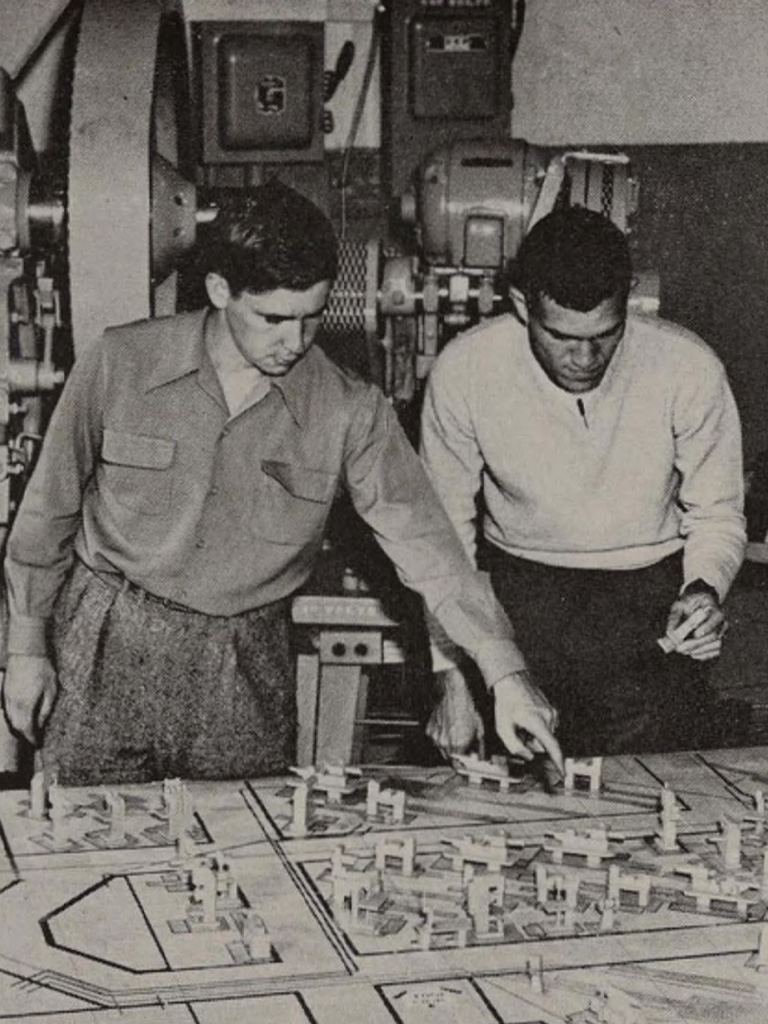
Front Image: Stanford GSB students at work in the school’s new Industrial Laboratory after it opened in the late 1940s. GSB Archives | Back image: Elena Zhukova.
Stanford GSB grads have always gone into sectors where they can make an impact. In the school’s first decades, that meant industry. When professor of industrial management Paul Holden surveyed the graduates of the first 10 MBA classes in 1939, he found that more than a quarter had gone into manufacturing, the biggest overall employer.
The San Francisco–Oakland Bay Bridge opened in 1936, built with over 167,000 tons of steel made by Columbia Steel — a top-three employer of Stanford GSB grads at the time. World War II further boosted the need for mass production, with steel fabrication, shipbuilding, automobile, and canning factories sprouting up in the Bay Area. As late as 1967, alumni employment surveys showed manufacturing as one of the top industries for graduates.
Classes at the GSB reflected these trends. The first MBA students were able to specialize in industrial management, with an emphasis in production control or plant engineering. In the 1930s, Production Management dove into equipment, operations, materials, and orders. In 1944, the Chrysler Corporation gave the school a scale layout of a Plymouth auto plant. Measuring 7 feet high by 28 feet long, it covered an entire classroom wall.
In 1947–1948, the business school introduced two more production courses, taught in the new Industrial Laboratory. A precursor to today’s Startup Garage? Perhaps. Frank K. Shallenberger, an associate professor of industrial management, said the lab would “provide students realistic and practical training in production management at the shop level.” With $30,000 worth of donated equipment — including a milling machine, drill presses, lathes, and a band saw — students created small-scale manufacturing projects. The first class created a production line model for 50 circular saws; the next class designed operations for the manufacture of 500 miniature electric motors.
Manufacturing I and II were required for all MBA students in 1960, covering plant facilities, materials handling, production planning, and product development. Additional second-year courses included Manufacturing Control,Manufacturing Policy, and Manufacturing Processes and Methods — the last offered jointly with the School of Engineering, with lab work, field trips, and methods analyses in nearby industrial plants.
With the rise of the service-based economy and technological advancements of the 1970s, career and course trends shifted away from manufacturing. The heyday of American manufacturing was coming to an end. But for a while, the factory floor ruled supreme, and Stanford GSB grads led operations.