Spurring Startup Success: Celebrating Thirty Years of CES
Since 1996, the Center for Entrepreneurial Studies has helped launch hundreds of companies.
written by Kevin Cool
Front photo: Elena Zhukova | Back photo: GSB Archives
Doug Ricket believes. Sarah Buchner believes. Thousands of alumni like them, including hundreds who have started their own companies, believe.
Thirty years after the Center for Entrepreneurial Studies was established at Stanford Graduate School of Business, its impact on the lives and futures of two generations of company founders is exemplified by stories like those of Ricket and Buchner. “CES was foundational to my own entrepreneurial path, providing the environment, guidance, and network that helped shape Trunk Tools and therefore me,” says Buchner, MBA ’22, whose company provides AI solutions to the construction industry. Motivated in part by her gratitude, she comes back to campus to help teach a new generation, as does Ricket, whose fintech company, PayJoy, provides credit to people without bank accounts or credit history. “I have visited the GSB for the Business Intelligence from Big Data class every year since graduation,” notes Ricket, MBA ’14, who also helps out in two other courses.
Stanford GSB has always been fertile ground for dreamers and doers, a place that nourishes the new. Yet when A. Michael Spence, then dean of Stanford GSB (and a future Nobel laureate), summoned lecturer Irving Grousbeck and professor of management Charles Holloway to his office one day in 1993, entrepreneurship education barely existed at the business school. There were only three course offerings, little in the way of curriculum development, and almost no research, Grousbeck recalls. “It was a desert.”
Moreover, even though Sand Hill Road — the epicenter of Silicon Valley dealmaking — was a 10-minute drive from campus, Stanford GSB had no established program that might capitalize on its proximity to the world’s leading engine of business development. Spence was determined to change that.
“We believed that this aspect of education… would and should expand as student and faculty interest grew,” Spence recalls. “It was also a competitive move. Most, if not all, top business schools were moving in this direction. We wanted to be in the lead, and we had the advantage, along with our local colleagues at Berkeley, Santa Clara, etc., of being in Silicon Valley.”
CES was foundational to my own entrepreneurial path, providing the environment, guidance, and network that helped shape Trunk Tools and therefore me.
— Sarah Buchner
Spence asked Grousbeck, now the MBA Class of 1980 Adjunct Professor of Management, and Holloway, now the Kleiner Perkins Caufield & Byers Professor of Management, Emeritus, to establish a program in entrepreneurial studies and raise the money to fund it. “Chuck Holloway had a long and deep history and involvement with building the school,” says Spence, the Philip H. Knight Professor and Dean, Emeritus. “Irv’s combination of a distinguished career in business and finance and his obvious dedication to the students and a gift for teaching made him a natural leader and partner.”
First, Spence had to convince them. “We needed to assure them that this was not a marketing ploy, and that we had a real commitment to supporting them in building the center,” he says.
In addition to the challenges of fundraising, Grousbeck and Holloway had to overcome the skepticism of some fellow faculty that entrepreneurship was a valid area of study. “They looked at it with sort of a fishy eye,” Grousbeck says. The prevailing attitude was that entrepreneurship “was all about emotion — take risks, break things, etc. — but what are they actually teaching?”
He and Holloway set out to demystify the process, “to make it logical.”
Three years later, the Center for Entrepreneurial Studies was born. CES has since helped nurture hundreds of successful enterprises. It has also established Stanford GSB’s name as a leader in entrepreneurial training and an important source of talent for the startup world.
The CES Playbook
Over the past three decades, CES and its affiliated faculty have focused on building world-class learning experiences — both in the classroom and in co-curricular programs — and on conducting research projects related to entrepreneurship.
“Today the GSB offers more than 50 courses related to entrepreneurship and innovation,” says CES director Deb Whitman, “allowing entrepreneurially interested students to curate a course plan that suits their personal learning goals.” In addition, “they can augment their GSB courses with entrepreneurial classes at nearly every other Stanford school.”
Grousbeck developed and taught Formation of New Ventures before CES was established, and it remains a foundational course, along with Managing Growing Enterprises, which aims to help prospective founders deepen their understanding of challenges facing a company or nonprofit seeking to scale up. The courses use real-world cases as teaching modules.
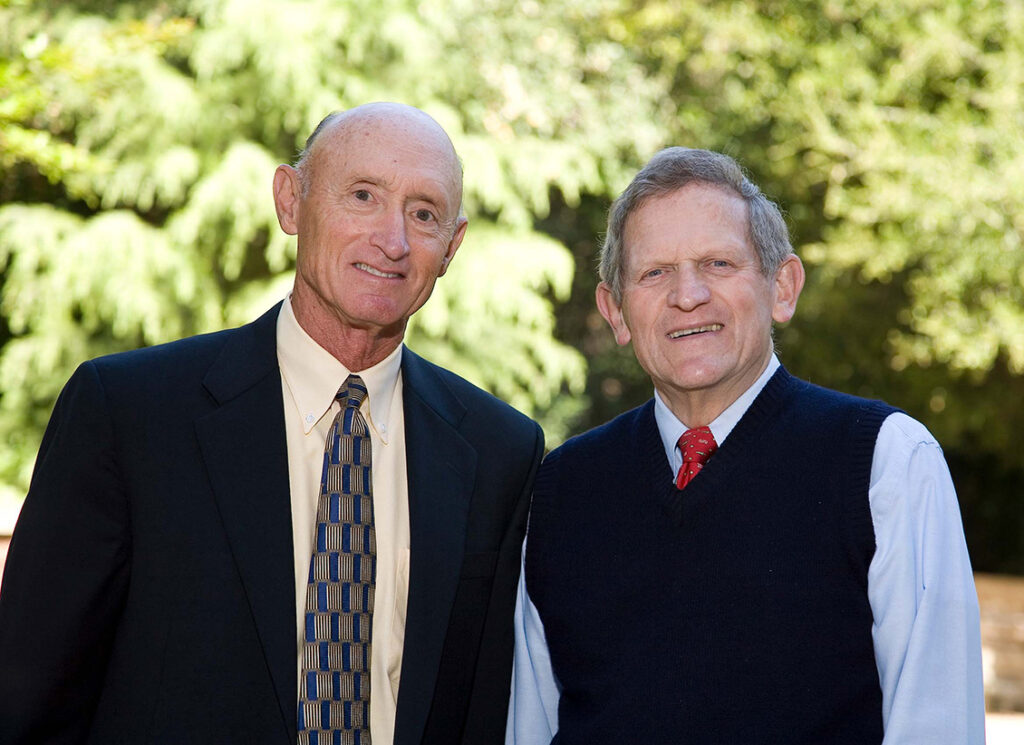
Charles Holloway, Stanford GSB professor and co-founder of CES (at left) shown with John Morgridge, MBA ’57, former CEO and chairman of Cisco Systems; the pair taught together for several years after Holloway helped pioneer the co-teaching model at the business school. | GSB Archives
Early on, Holloway recognized that the program needed teaching partners who had founded or led companies themselves. His first call was to his friend John Morgridge, MBA ’57, the former CEO and chairman of Cisco Systems. “He had recently retired, so he and I taught together for several years,” Holloway recalls. It was a new model, a proof of concept, and it worked. “That was Chuck’s genius, pairing us with people from the outside,” says Grousbeck. And although alumni were often the best picks for practitioner-teachers, that wasn’t always the case. Grousbeck recalls co-teaching with Seattle Mariners owner and CEO John Stanton, even though Stanton had no association with Stanford.
One of the challenges, Holloway points out, was that the lecturers had deep domain expertise, but sometimes didn’t know much about teaching. But they were willing to learn. “They were very committed,” he says.
Garth Saloner, former CES faculty director and Stanford GSB dean, says the entrepreneurial coursework digs into the fundamentals first, answering questions that all founders will encounter: “What makes a great founder? How do you evaluate ideas? How do you raise money or put a board together? And then what do you do with your baby once it’s fully grown? There’s a set of conceptual frameworks that drive the arc of the courses.”
Those questions haven’t changed in 30 years, but the answers change depending on the current environment, says Saloner, the Botha-Chan Professor of Economics. “Right now, it’s all AI, all the time, in people’s minds, so, in a very frothy environment, how do you think about whether you should be going into that space?”
Today the GSB offers more than 50 GSB courses related to entrepreneurship and innovation, allowing entrepreneurially interested students to curate a course plan that suits their personal learning goals.
— Deb Whitman
One of the most immersive exercises in Formation of New Ventures is Pitch Day. A venture capitalist is invited to class to hear students present their ideas and share feedback about each venture as the pitch progresses. Saloner stresses that this is not a simulation. “It’s a real opportunity for them to get in front of a VC. Sometimes it goes somewhere, but often, of course, it doesn’t. But learning happens in those interactions.” Students are taught to ask themselves, “What is the body language telling me about whether this is going well?”
“I found the entrepreneurship classes extremely stimulating — Formation of New Ventures and Managing Growing Enterprises were two of my all-time favorite classes,” says Ricket. “One lesson that sticks with me to this day came from the Family Business course. The key lesson for me was to see the issues of control of a business and economic interest in a business as two separate things.” He says that insight contributed to PayJoy’s success by making him more willing to take a smaller ownership stake to attract more investors, while maintaining control as the CEO/founder, so the company “remained true to its social justice mission.”
From the beginning, Grousbeck and Holloway recognized the value of developing cases about companies located on the West Coast. They hired recent graduates as case writers and began assembling a portfolio to provide a distinctive set of teaching materials. CES continues to update its library of cases to ensure contemporary relevance. “You can’t teach 30-year-old cases in entrepreneurship courses,” Whitman notes. “They have to be pretty current.”
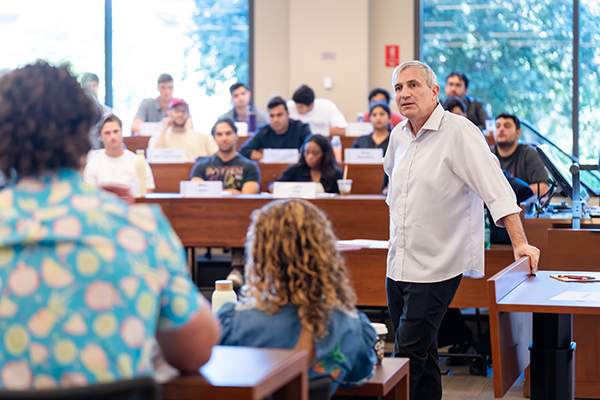
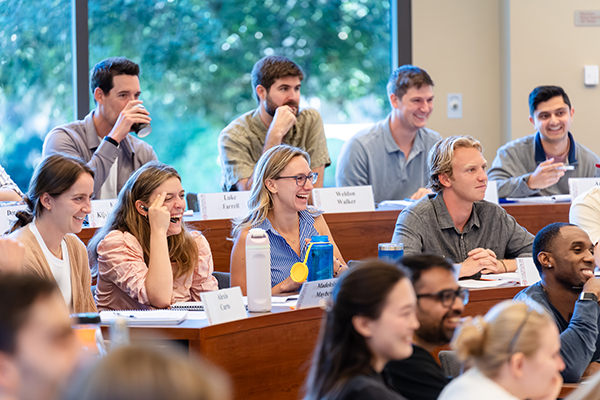
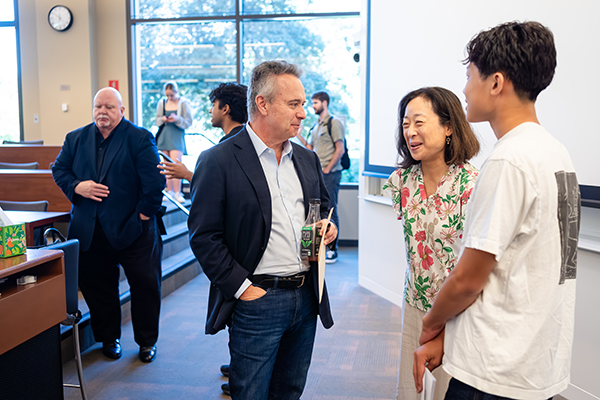
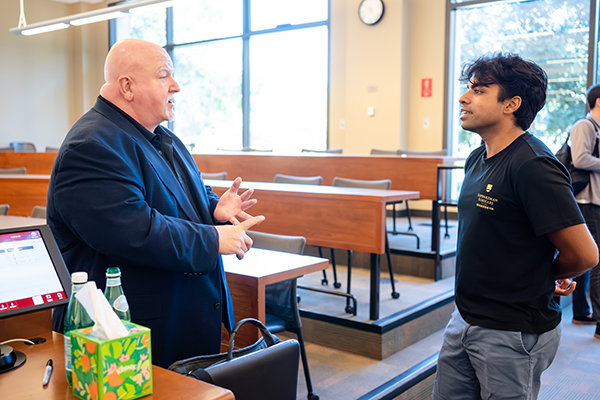
Yossi Feinberg, the Adams Distinguished Professor of Management and Professor of Economics, shown teaching a “Formation of New Ventures” class.“Formation of New Ventures” remains a core CES course. | SF PhotoLecturer Scott Brady in the “Formation of New Ventures” class | SF PhotoJim Ellis, a lecturer in management, shown here at left, speaking with a student in the “Formation of New Ventures” course | SF Photo
A Chance to Try It On
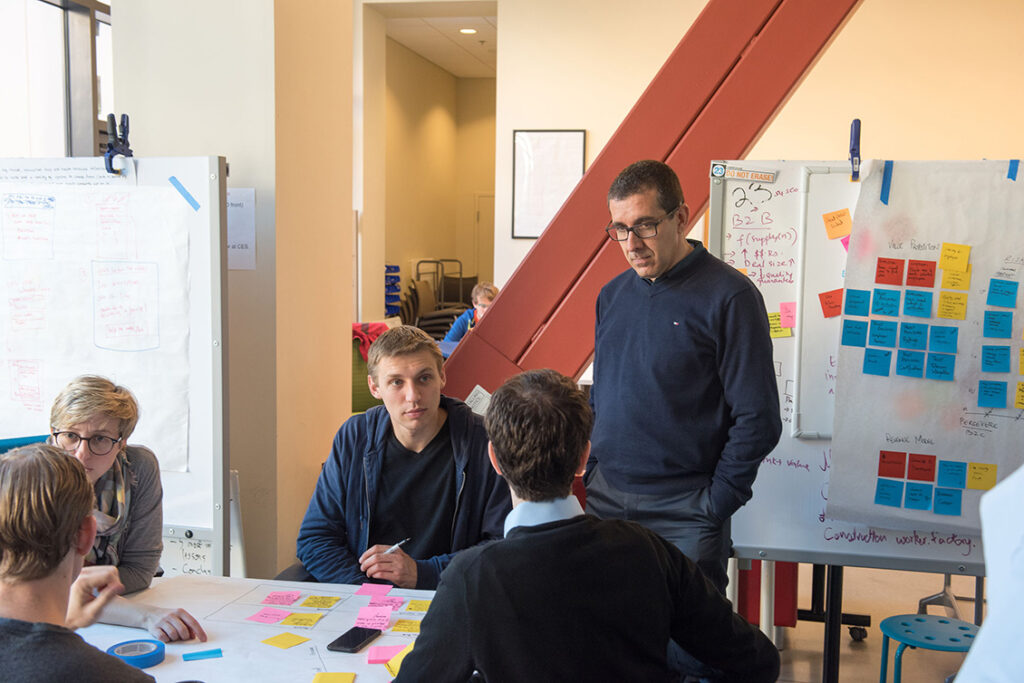
Case-based learning is essential, but in 2012, professor and CES faculty director Stefanos Zenios designed a course in which “the students use their own cases” as the learning model. Startup Garage, which Zenios continues to lead, is a two-quarter immersion in the nuts and bolts of birthing a company. Students arrive with an idea for addressing an unmet customer need, then test the hypothesis, develop a business model, and go through the steps of launching a new enterprise. Along the way, Zenios says, they encounter the same challenges that entrepreneurs face in the real world. “We give them repeatable frameworks they can use regardless of what the startup involves,” he says. “They learn to think and operate like a scientist,” using data, customer insight, and design thinking principles that lead them toward solutions.
Professor Stefanos Zenios created the two-quarter course “Startup Garage” to teach students how to build a company from the ground up. | GSB Archives
More than 100 successful companies across a wide range of industries have launched since the founders participated in Startup Garage. The best known is DoorDash, the food delivery service co-founded by Tony Xu, MBA ’13. Zenios, the Investment Group of Santa Barbara Professor of Entrepreneurship, says the company exemplifies “precedents thinking,” in which an entrepreneur borrows from other business models to craft their own. “DoorDash was a combination of Uber, Domino’s, and FedEx,” he explains. It’s also an example of how the course has informed Zenios’s research: He recently published an article about precedents thinking based on what he has observed in Startup Garage.
We give them repeatable frameworks they can use regardless of what the startup involves.
— Stefanos Zenios
Students also have opportunities to learn about entrepreneurship outside the classroom through several co-curricular programs. CES arranges summer internships that match students with early-stage startups. The idea, Whitman says, is to see whether entrepreneurship itself is a good fit. “Many students find the sometimes hectic world of early-stage startups exciting and get more certain about this as a career path, but a few decide that the chaos is off-putting and opt to go back to something more stable. Either way, they get the opportunity to try out the startup world at a low-risk time in their careers.”
Students who are convinced they want to build a company of their own can engage in CES summer programs, such as the Botha-Chan Innovation Program, which unpacks the startup process. “Students spend eight weeks in the summer learning to evaluate a startup idea of their own creation, based on the process we teach in the Startup Garage course,” Whitman says. “It’s a really rich summer learning experience.”
Thirty Years of Impact
It’s natural to reflect on how CES has made a difference when celebrating its anniversary. For Grousbeck, perhaps the center’s most ardent champion, the program has had several positive “radiating effects.”
“One is the students you teach, some of whom go out and get involved in entrepreneurial ventures, and they talk about the courses and the thinking that went with them,” he says. “The same word-of-mouth happened with faculty and lecturers, our financial supporters, and other people who came on.” It created a virtuous cycle that benefited faculty and student recruiting, fundraising, and ongoing volunteer support.
If you come to Stanford with even a hint that this might be what you want to do… we will equip you by the time you graduate to go out and do this.
— Garth Saloner
Today, nearly two-thirds of incoming students indicate a strong interest in learning about entrepreneurship, and about one-third of graduating students are actively engaged in entrepreneurship in their first job beyond the GSB.
Other numbers convey a similar story about the energy and accomplishment associated with entrepreneurship since CES was established. According to the center’s inaugural GSB Alumni Entrepreneurs 2025 Report, 3,539 MBAs from the classes of 1997–2021 launched companies, representing 39% of the graduates from those years. Moreover, 33% of those alumni started more than one company. When combined with MSx alumni founders from the classes of 1997–2021, the total of new companies rises to more than 5,500.
Saloner says Stanford GSB has become the “destination of choice” for people interested in pursuing entrepreneurship, and CES has helped enable that. “It’s a complex area, very nuanced. If you come to Stanford with even a hint that this might be what you want to do, and you conclude that it is, we will equip you by the time you graduate to go out and do this.
“I just think that’s a great accomplishment for the school.”