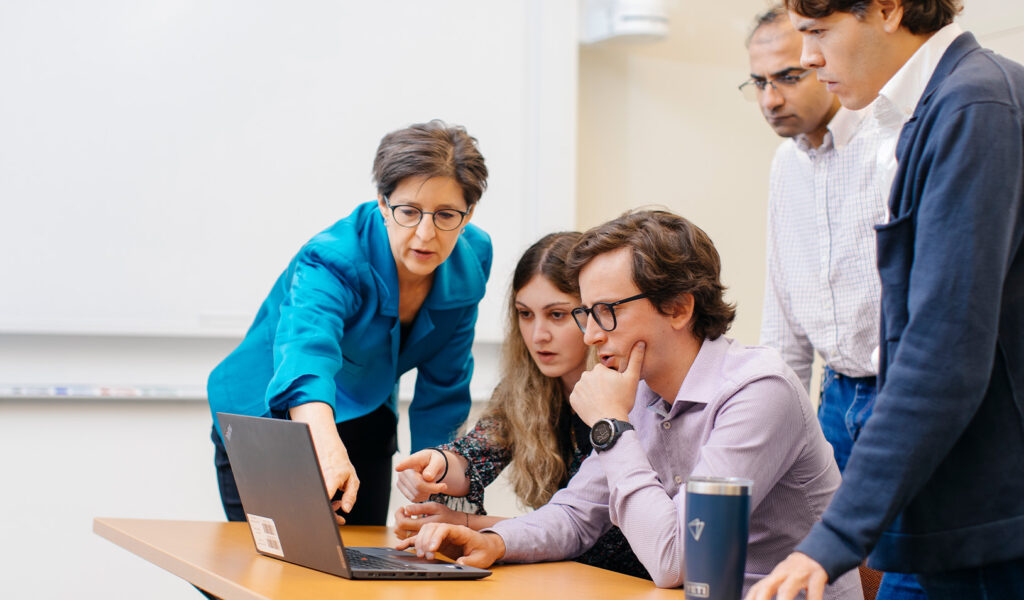
Stanford GSB faculty — such as Professor Susan Athey, shown here with Golub Lab students — students, and staff are making AI an integral part of programming across the school | Photo by Elena Zhukova
Located in the tech center of Silicon Valley, the school is enhancing its offerings of courses, research, and programming centered around artificial intelligence.
Stanford Graduate School of Business prepares students to be future leaders and innovators in their respective fields — whether it’s tech, finance, corporate, or consulting. Located in the heart of Silicon Valley, Stanford GSB is now uniquely positioned to help students and alumni harness the power of AI while also understanding and mitigating its potential risks. As technology and its capabilities rapidly evolve, Stanford GSB is intensifying its commitment to AI through programming, coursework, and faculty research.
“AI is changing all aspects of organizations and forcing leaders to reconsider how value gets created,” says Sarah A. Soule, the Philip H. Knight Professor and Dean at Stanford GSB and Morgridge Professor of Organizational Behavior. “This is true at the GSB, where we are reimagining what it means to educate leaders in the age of AI.”
Most recently, the school has announced AI@GSB, a student-led AI applied initiative that will highlight and bring together some of the top learning opportunities around AI to Stanford GSB. The program will incorporate hands-on workshops led by industry experts and created in collaboration with student scholars, a dean’s speaker series with AI leaders, and foundational primers for students to enhance their AI literacy and learning.
Classroom Focus
In response to evolving corporate environments and student needs, new coursework has been introduced that focuses on training future leaders to think about AI. As part of the curriculum, Stanford GSB faculty members teach students how to use AI and machine learning to solve real-world industry challenges. They invite AI entrepreneurs, investors, and executives as guest speakers and co-teachers to discuss practical applications and provide hands-on exercises.
We are preparing our students to lead at the forefront of the AI transformation.
— Sarah A. Soule
In 2024–25, some 20 GSB courses highlighted or integrated AI or machine learning. In 2025–26, that number increased to around three dozen courses for MBA and MSx students.
Some of the focused courses integrate AI as a key component of business applications and use within corporate environments, such as the following:
Understanding AI Technology for Business Problems
AI and Data Science: Strategy, Management, and Entrepreneurship
AI²: Artificial Intelligence and Accounting Information
Future of AI in Work: A Lab for Startups
AI & Power: Five Big Questions
Other courses, including The AI-powered Org: Evolution, Rebirth, or Death? and AI for Human Flourishing, examine the theoretical and impact questions around AI. And yet others integrate AI as a learning tool with hands-on practical applications, such as Startup Garage — which kicks off with a 60-minute AI-powered “hackathon” — Organizational Analytics, and Advanced Optimization and Simulation Modeling.
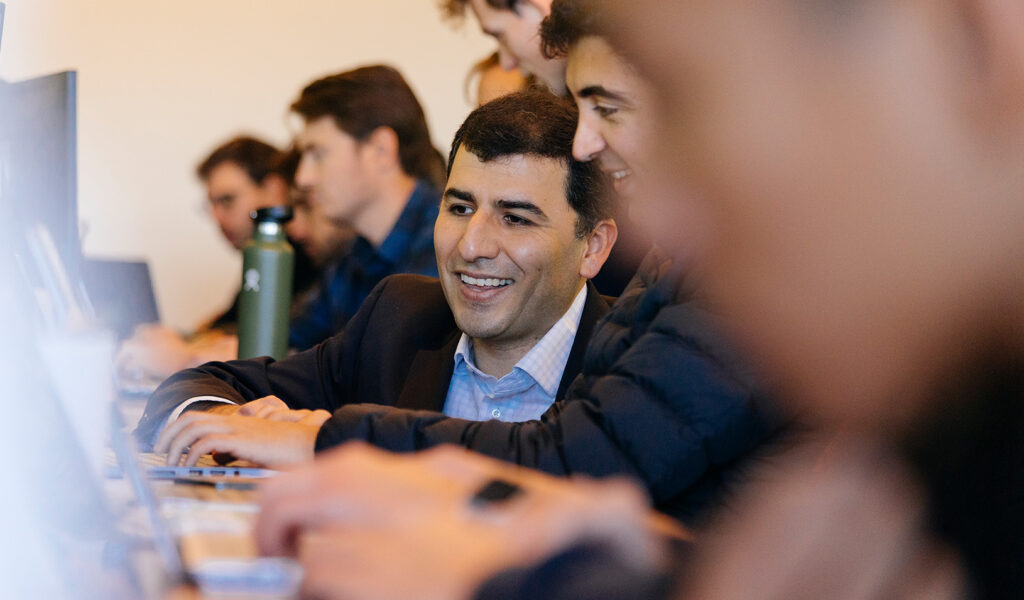
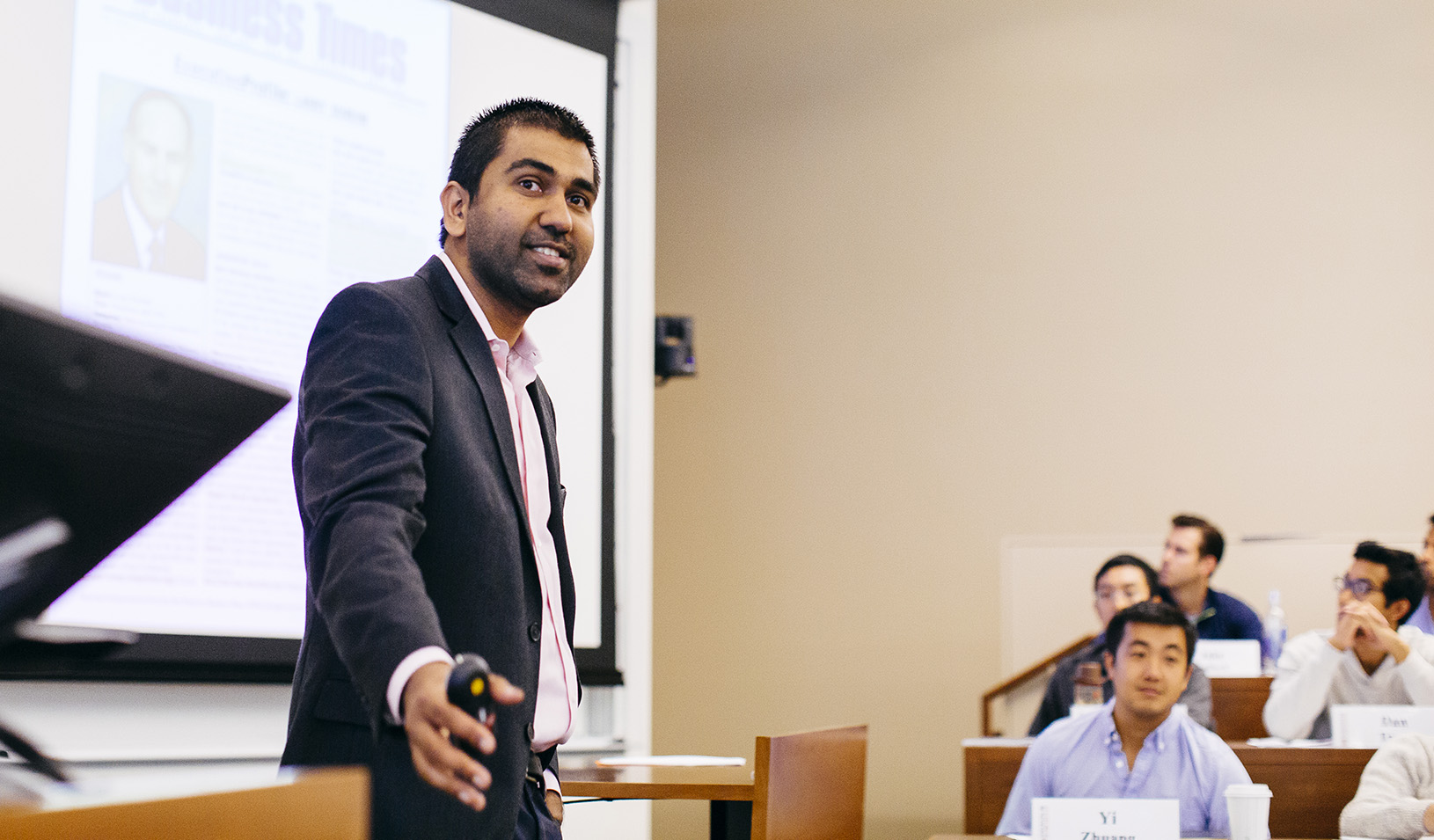
Stanford GSB faculty are increasingly bringing their AI scholarship and research into the classroom (operations, information, and technology professor Mohsen Bayati shown here with students) | Photo by Elena Zhukova
Stanford GSB faculty are increasingly bringing their AI scholarship and research into the classroom (operations, information, and technology professor Mohsen Bayati shown here with students) | Elena Zhukova
Stanford GSB students have driven other events. The Artificial Intelligence Club was founded in 2021 to highlight AI innovations and business impact for both Stanford GSB and the broader Stanford community. Last year, the club planned over 15 events, including panels, discussions, and fireside chats with industry leaders. More events, along with a January conference, are planned for this academic year.
AI is also playing a prominent role in many student venture ideas. Stanford Venture Studio’s Demo Day 2025 featured several teams presenting their AI-driven venture ideas to alumni, faculty, and students. A number of awardees of the Center for Social Innovation’s Stanford Impact Founder Fellowship are using AI to tackle real-world social issues. And many students in Stanford GSB summer programs that focus on evaluating startup ideas — the Botha Chan Innovation Program and the Ecopreneurial Summer Innovation Sprint (Eco-Sprint)— worked on projects where AI is a key part of their solution.
Stanford Venture Studio is also hosting a “Zero to App” two-part pilot workshop series, along with networking opportunities and technical office hours (with Amazon Web Services), for interested students.
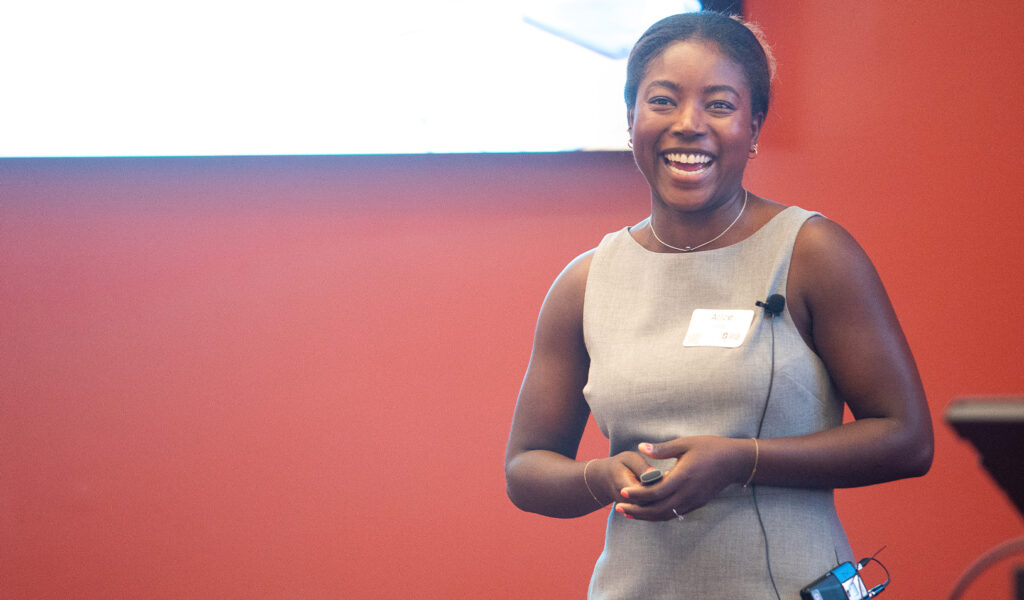
Alice Obas, MBA ’26, was one of the students presenting their AI-driven venture ideas to the broader Stanford GSB community as part of Demo Day 2025. | Photo by Saul Bromberger
In addition, “AI has transformed our approach to career support,” says Jamie Schein, assistant dean and director of the Career Management Center (CMC). The CMC is leveraging AI tools and agents to enable more efficient and effective job searches for students and alumni, while also increasing its focus on AI-centered job opportunities.
School-Wide Offerings
Centers and initiatives at Stanford GSB have expanded their offerings to include AI-focused events for students, faculty, alumni, and the public. In February, the Value Chain Innovation Initiative launched a popular speaker series; the first season, AI-Powered Innovation, featured leading practitioners discussing how AI is driving innovation across industries in one-hour webinars moderated by Haim Mendelson, the Kleiner Perkins Caufield & Byers Professor of Electronic Business and Commerce, and Management. In addition, the Center for Social Innovation presented a panel on AI & Nonprofit Boards in collaboration with Stanford Women on Boards and the Alumni Consulting Team.
These offerings build on programming over the last two years that has explored the rise of AI, the evolution of the industry, and its impact on business and society. This programming includes grants for new faculty research on AI and a series of quarterly AI flash talks in which Stanford GSB faculty present topical research to students and peers. Biannual AI conferences continue to bring together academic and industry practitioners to discuss the latest challenges and envision new solutions, including an AI & Marketing conference scheduled for November 21–22, 2025.
Artificial intelligence is a focus area for the recently announced Initiative for Investing, centered around the transformative aspects of AI on investing, to be further examined at its January 2026 inaugural conference, Stanford GSB Investor Summit. The Initiative for Investing also plans to collaborate with student-led clubs to bring in speakers to address the impact of AI on the investing industry. The initiative serves as a hub for the Stanford GSB investing community — bringing together faculty, alumni, and students to connect, collaborate, share insights, and explore emerging investment trends and innovations.
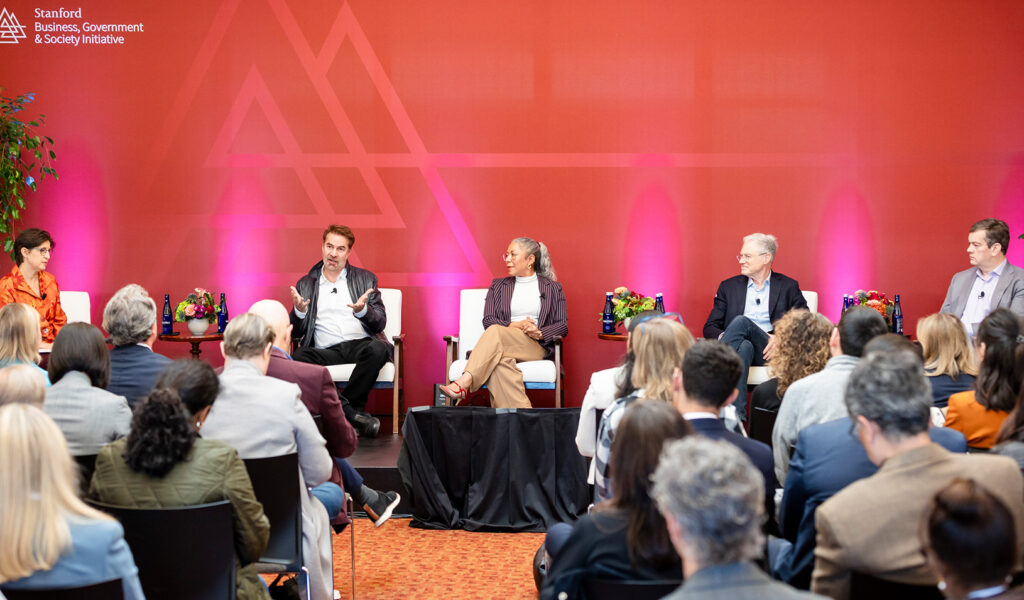
AI was a central theme at a forum at Stanford GSB last spring, featuring key scholars and business leaders in the field.
The GSB Artificial Intelligence Community of Practice (GSB AI COP) was recently launched for staff — a collaborative, grassroots initiative designed to facilitate conversation and learning amidst the rapidly evolving AI landscape. An initial afternoon event included keynote presentations, lightning talks, and breakout sessions centered around technological developments and AI applications for professional development and community impact.
Research Frontiers
Faculty research is a cornerstone of AI work at Stanford GSB, helping to further theoretical and practical findings, as well as applications of the technology across all sectors — including within the classroom.
For example, Mohsen Bayati, the Carl and Marilynn Thoma Professor of Operations, Information & Technology, studies applied machine learning in healthcare, examining ways to improve healthcare using data-driven learning and decision models. Susan Athey, PhD ’95, the Economics of Technology Professor, is a leading voice on the intersection of machine learning and econometrics, studying the application of technology for social impact. Amir Goldberg, a professor of organizational behavior, examines the intersection of cultural sociology, data science, and organization studies, using and studying AI methods as a central part of his research. Yuyan Wang, an assistant professor of marketing, brings years of industry experience to her interest in leveraging theory and behavioral insights to design AI and machine-learning solutions and improve recommender systems.
Stanford GSB also provides additional AI and machine-learning research opportunities to its student, faculty, and staff community. The Golub Capital Social Impact Lab, headed by Athey, uses AI and machine learning to improve and catalyze the impact of pressing social challenges.
The business school community has access to the Stanford GSB Research Hub for its AI services and resources; as part of the Research Hub, the Data, Analytics, and Research Computing (DARC) team works with faculty to tackle challenging research questions using data analysis and machine learning. As of this year, Stanford GSB researchers can access Marlowe, Stanford’s new “superpod” of 248 Nvidia H100 GPUs. And all Stanford GSB students, faculty, and staff can access a wide array of AI tools and agents on the Stanford AI Playground, a user-friendly platform built on open-source technology.
In this period of tremendous learning and opportunity, within the center of innovation in Silicon Valley, Stanford GSB is integrating AI into business education. “We are preparing our students to lead at the forefront of the AI transformation,” Soule says.