The Unforgettably Challenging Course MBAs Line up to Take
Written by Kevin Cool
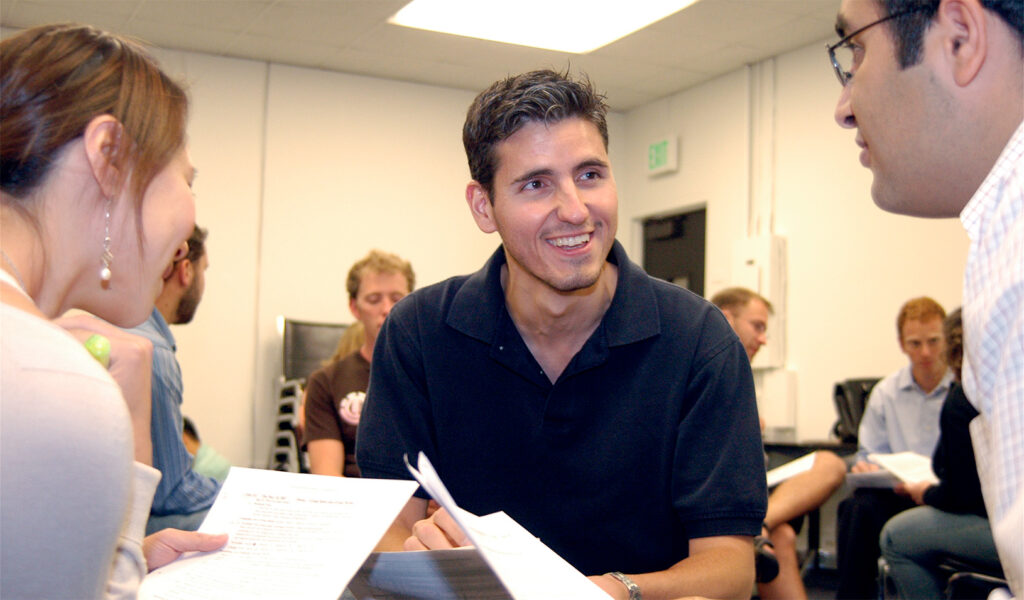
One of the most popular elective courses at Stanford GSB, Interpersonal Dynamics was introduced in 1968. | GSB Archives
Decades of students have learned about emotional intelligence in this fabled Stanford GSB course.
If you want to elicit a smile — or perhaps a grimace — from Stanford GSB alums who took Interpersonal Dynamics, ask them about the Influence Line.
Among the legion of students whose affection and praise for the course they dubbed Touchy-Feely has made it a fabled part of the Stanford GSB experience, the Influence Line holds a special place.
Visualize 12 students sitting in a classroom. One by one, the students stand and place their classmates in a line based on how influential they believe each student is. They also rate themselves. By the end of the exercise, students may have appeared in the front of the line in some cases and at the end in others.
Hearing how your peers perceive you can be excruciating, says longtime course instructor Andrea Corney, MBA ’89, especially if that assessment is different from your own. “We tell students, you will be uncomfortable. You may have sleepless nights.” Although discomfort may result, that is not the aim: The rating is grist for discussion about why influence is gained or lost. And it is part of an ethos of truth-telling that gives Touchy-Feely its juice.
The Influence Line exemplifies the course’s immersive training in how to develop strong relationships and why doing so is crucial for successful leadership. “What are you learning about why classmates placed you there in the line, and what could you do differently to change it? A lot of students tell us the Influence Line was where they learned the most about themselves and how to change their behavior,” Corney says.
Interpersonal Dynamics is one of the most popular non-core courses in the history of Stanford GSB. More than 90% of MBA students enroll in one of the 12 sections offered each year, and it’s also popular with executive education cohorts. The course is now an indispensable piece of the GSB’s leadership training. But it wasn’t always that way.
The T-Group Revolution
David Bradford, the Eugene D. O’Kelly II Senior Lecturer in Leadership, Emeritus, arrived at Stanford GSB in 1969. He inherited Interpersonal Dynamics from lecturer Ken Knight, who had introduced it a year earlier. But it was Bradford and other colleagues who shaped what the course would become. Jerry Porras, the Lane Professor of Organizational Behavior and Change, Emeritus, arrived at Stanford GSB two years later from UCLA, where he was involved in a similar course. Lecturer Mary Ann Huckabay joined the team in the mid-1970s and is credited with several innovations, such as a course reader she compiled along with Bradford that is still in use at other schools, including Yale and the University of Chicago.
Bradford was familiar with the T-group model, a training method developed in 1947 by Kurt Lewin, one of the founders of modern social psychology. Essentially, T-groups (the “T” is for “training”) are learning labs in which the interactions between a small group of students — typically a dozen or so — are processed and analyzed. Class sessions are loosely structured and rarely include lectures. Instead, teachers invite students to give feedback about their classmates’ behavior as they discuss whatever topic happens to arise.
Course faculty, including former professor Lara Tiedens (shown here in 2007) guide students to learn from each other. | GSB Archives
Early in the development of the T-group model, says Bradford, a critical insight emerged: No one knows the impact that their behavior has on other people until someone else in the group points it out.
“Students don’t learn from the teacher, they learn from each other,” says Bradford. “We were building a group culture where people could share their reactions, and that wasn’t always easy to hear. People came into the course with a certain view of themselves, thinking they were influential. Until someone said, ‘No, you don’t influence me. When you do this, it turns me off.’”
“What we were really teaching,” Bradford says, “was emotional intelligence.”
People can expect a transformative experience, and that can take many shapes and forms.
— Ed Batista
After the first couple of years, the teaching team began hearing anecdotes that suggested Interpersonal Dynamics was making an impact. Bradford recalls being stopped in the hallway by an accounting professor who said his students needed what the course was teaching. “He said, ‘Accounting students don’t fail because they don’t know accounting. They fail because they’re interpersonally unskilled.’”
Not everyone was so magnanimous. Some faculty members felt the course was insufficiently rigorous. Acceptance came slowly, driven largely by student demand, Bradford says.
As recognition grew that soft skills were crucial for effective leadership, Touchy-Feely was eventually embraced. “Nobody says it’s not relevant anymore,” Corney says.
Along with the Growth, Some Grit
Misconceptions about Interpersonal Dynamics are common. But those closest to the program — including the many alumni who found it helpful — say people are wrong if they infer from its fanciful nickname that the course is frothy or insubstantial. Indeed, that notion belies one of the course’s essential goals: toughening the skins of future leaders.
Start with this: Being honest is hard. Many people are reluctant to provide feedback that may be perceived as negative. T-groups encourage participants to both give and get honest reactions in a spirit of collegiality. “Feedback can provide learning for both since it says as much about the giver as the receiver,” says Bradford.
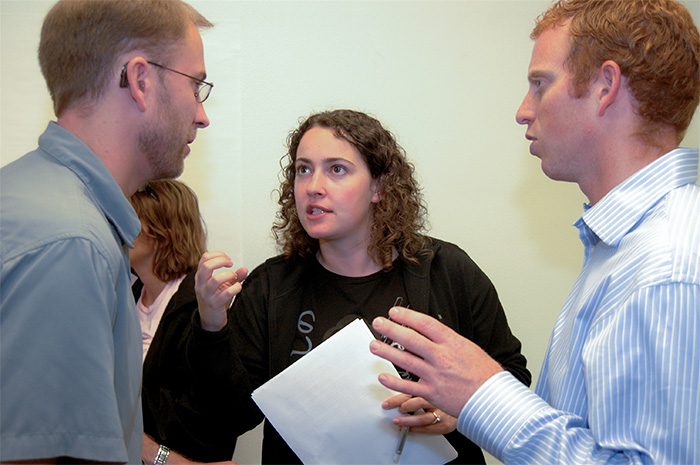
Peer feedback and student interactions are key to the success of the course, as shown here in 2007. | GSB Archives
“Touchy-Feely sometimes gets caricatured as ‘Just be nice and friendly and that’s the path to success,’’’ says executive coach Ed Batista, MBA ’00, who took the course and later taught it for several years. But the exercises are designed to be provocative. “A T-group is a laboratory for understanding how power and influence work.”
“Here is an opportunity to take some risks, to learn something about yourself, to learn something about the other people in this group, and to learn about how small groups operate in general,” Batista adds. “People can expect a transformative experience, and that can take many shapes and forms. There is a certain robustness and predictability to the methodology.”
Leslie Chin, who has taught the course and also completed its significant redesign in 2020, says that “empathic listening” is a cornerstone of the training. A goal is to teach students “how to interact with others in a way that generates connection and trust,” Chin says.
“Emotional intelligence is more correlated with high performance in senior leadership than technical skills,” she says. “Leaders need an ability to be consistent in the way they show up, communicate what’s expected, inspire other people.”
The benefits of Interpersonal Dynamics are well established, but Corney acknowledges that “it isn’t for everybody.” The course requires a level of vulnerability that’s too much for some. Moreover, now that it has become a de rigueur part of the GSB experience, some students may enroll for the wrong reasons. “There’s a good bit of social pressure to take the class, which I’m not sure is a healthy thing,” Batista says.
Three generations of Stanford GSB students have taken the course, and it has inspired an army of acolytes.
Executive coach Rebecca Zucker, MBA ’94, is among the thousands of alumni who still feel its effects. “I loved that class when I took it,” she says, “but I really appreciate now how fundamental and critical it is to think about your impact on other people. I learned a lot about myself in that class.”